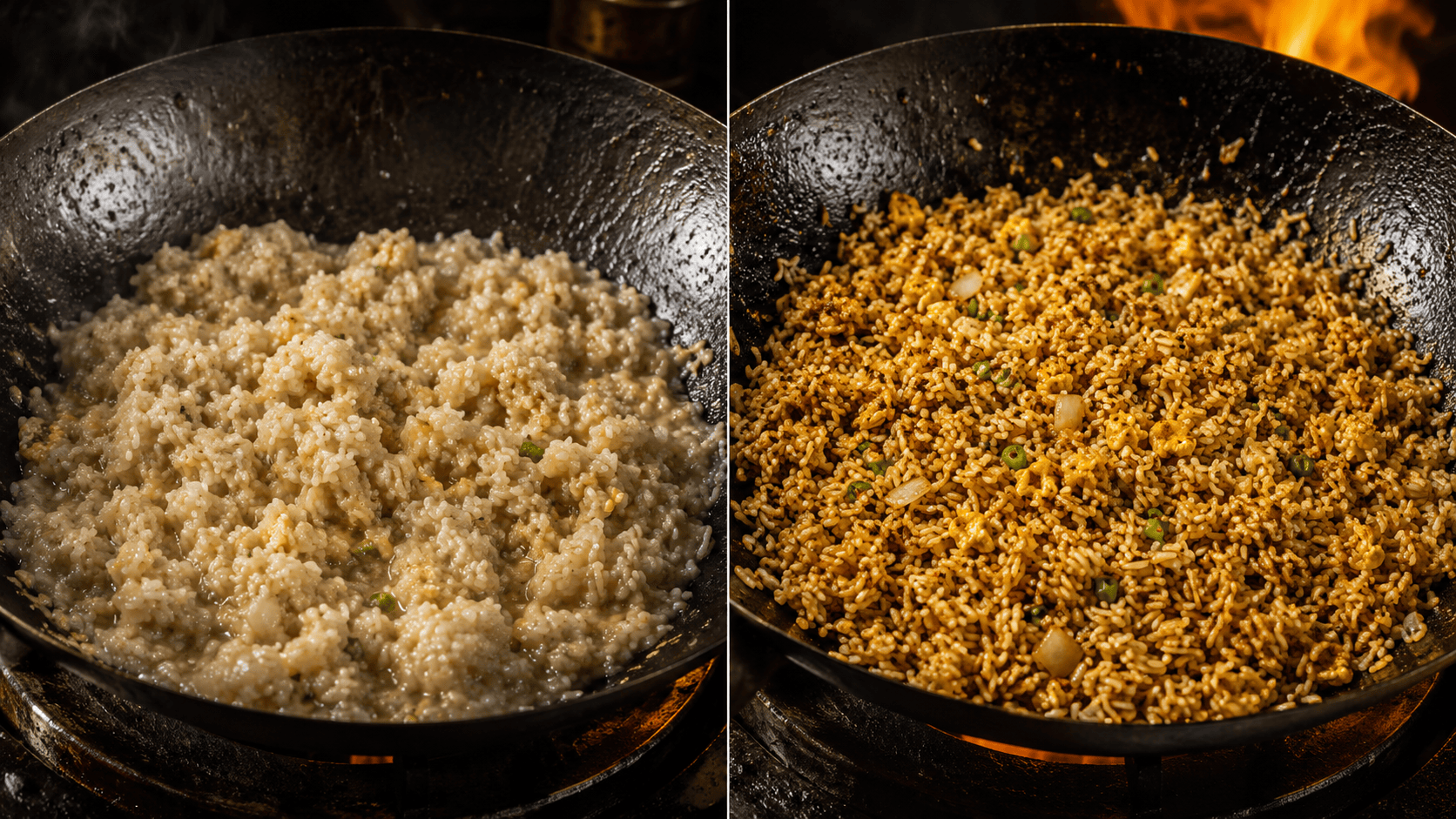
You made a pot of rice, let it cool for twenty minutes, and threw it into a hot wok. The result was a sticky mass that steamed instead of fried. Individual grains were a distant memory. The fried rice of your dreams was a clumpy reality.
The problem wasn’t your wok. It wasn’t your heat. It was the rice. Fresh rice is the enemy of fried rice. Here’s why.
The Starch Problem
Rice is mostly starch. When you cook rice, the starch granules absorb water and swell. This is gelatinization — the same process that thickens a sauce. Freshly cooked rice is full of swollen, sticky starch granules on the surface of every grain.
When you throw fresh rice into a hot wok, those sticky granules immediately clump together. The heat drives off surface moisture, but the starch has already glued the grains into clusters. You can’t fry them apart.
Day-old rice is different. During refrigeration, the starch undergoes retrogradation. The swollen starch molecules realign into a more ordered, crystalline structure. The grains firm up. The surface starch loses its stickiness. Each grain becomes a distinct unit that fries separately.
This is not a convenience hack. It is a chemical necessity.
The Wok Hei Factor
Fried rice at its best has wok hei — the breath of the wok. That smoky, charred flavor that comes from food hitting a screaming-hot carbon steel wok above a jet engine burner.
Home kitchens cannot replicate restaurant wok hei. But you can get close. The keys are a hot pan, dry rice, and not crowding the wok. Each grain should make contact with hot metal. Steam is the enemy. High heat plus dry rice equals fried texture. Steam equals mush.
The Fix for Perfect Fried Rice
1. Day-old rice from the fridge. Cook the rice, spread it on a tray to cool, refrigerate uncovered overnight. The fridge dries the surface. The retrogradation firms the grain. This is step one and it is non-negotiable.
2. Break up cold rice before cooking. Use your hands. Separate the grains while the rice is still cold. If you try to break up clumps in the wok, you will mash them, not separate them.
3. Hot wok, high smoke point oil. Peanut, vegetable, or avocado oil. The wok should be hot enough that the oil shimmers before the rice goes in.
4. Fry in batches if needed. Do not crowd the wok. More rice than the wok can handle means the temperature drops and everything steams. Cook what fits.
5. Add sauce at the end. Soy sauce, oyster sauce, whatever you’re using — drizzle it down the sides of the wok so it heats before it hits the rice. Cold sauce cools the rice and creates steam.
Your Fried Rice Checklist
- ☐ Rice cooked and refrigerated overnight
- ☐ Break up clumps by hand before cooking
- ☐ Hot wok, shimmering oil
- ☐ Don’t crowd. Fry in batches if needed
- ☐ Sauce goes down the sides of the wok, not on the rice
Day-old rice is not a suggestion. It is the whole technique.