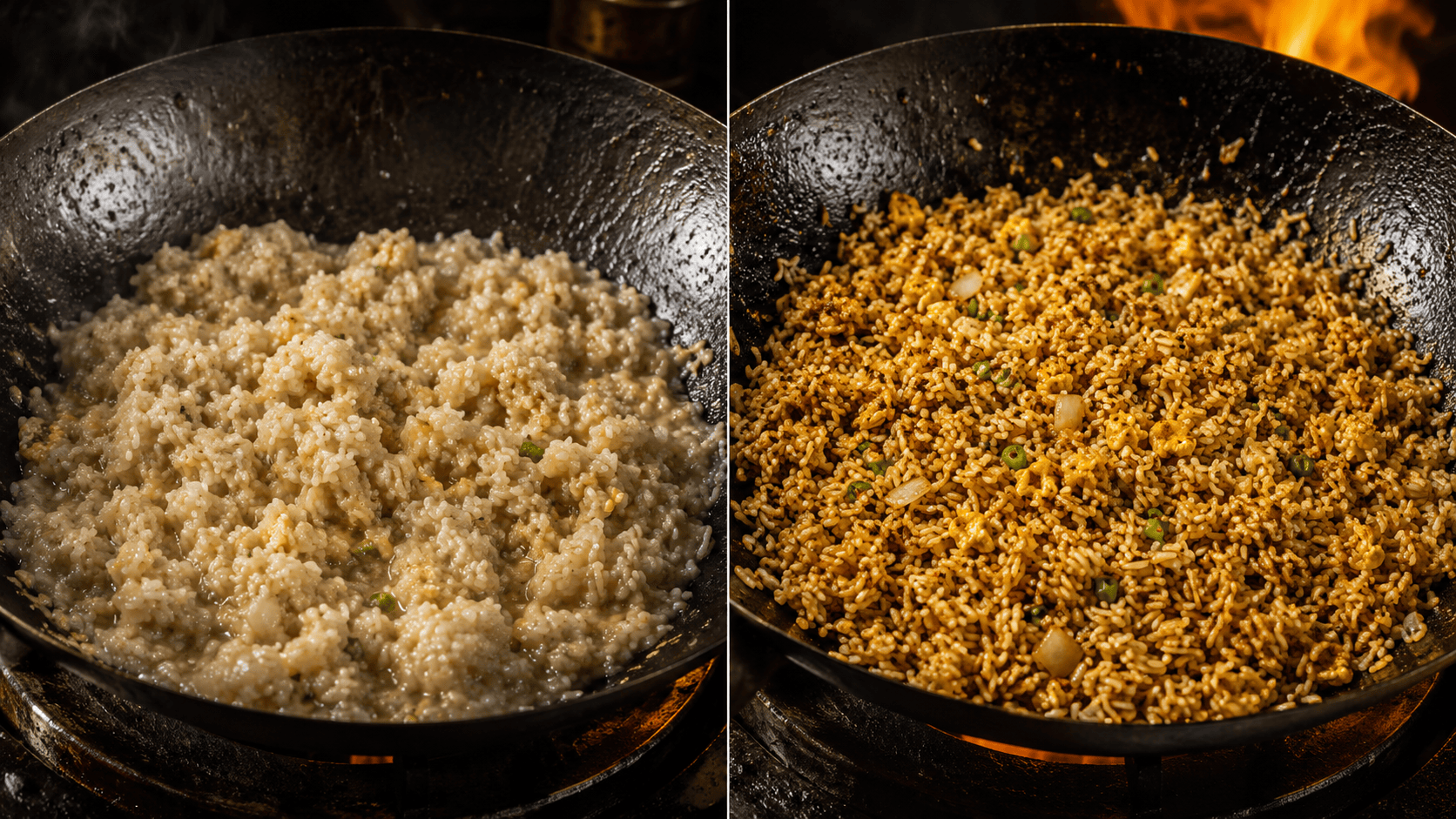
What probably happened
You used too much water, or you stirred the rice during cooking, or you didn't let it rest after cooking.
Why it happened
Rice grains are mostly starch granules held together by a protein matrix. When you cook rice, the starch granules absorb water and swell. If there's too much water, the granules burst and release loose starch into the cooking liquid, turning it into glue. Stirring during cooking physically ruptures the swollen granules, releasing even more starch. And skipping the rest means the steam hasn't had time to redistribute — the grains at the bottom are wetter than the grains at the top.
How to save it now
If the rice is already cooked and mushy, spread it on a sheet pan in a thin layer. The steam will escape quickly and the rice will dry out somewhat. It won't return to perfect individual grains, but it'll be less gummy. You can also turn it into fried rice — the high heat of a wok or skillet drives off moisture and crisps the exterior of the grains.
How to prevent it next time
Use the knuckle method or a 1:1.5 rice-to-water ratio for white rice. Bring to a boil, then immediately cover and reduce to the lowest heat. Do not lift the lid. Do not stir. Cook for the time on the package, then remove from heat and let it rest, covered, for 10 minutes. The rest is not optional — it's when the rice finishes absorbing water evenly.
Tiny kitchen test
Cook two pots of rice side by side with the same ratio. Stir one pot halfway through cooking. Leave the other untouched. The stirred pot will be a gummy block. The untouched pot will be separate, fluffy grains.
Still not working? Ask us on Instagram and we'll dig into it.