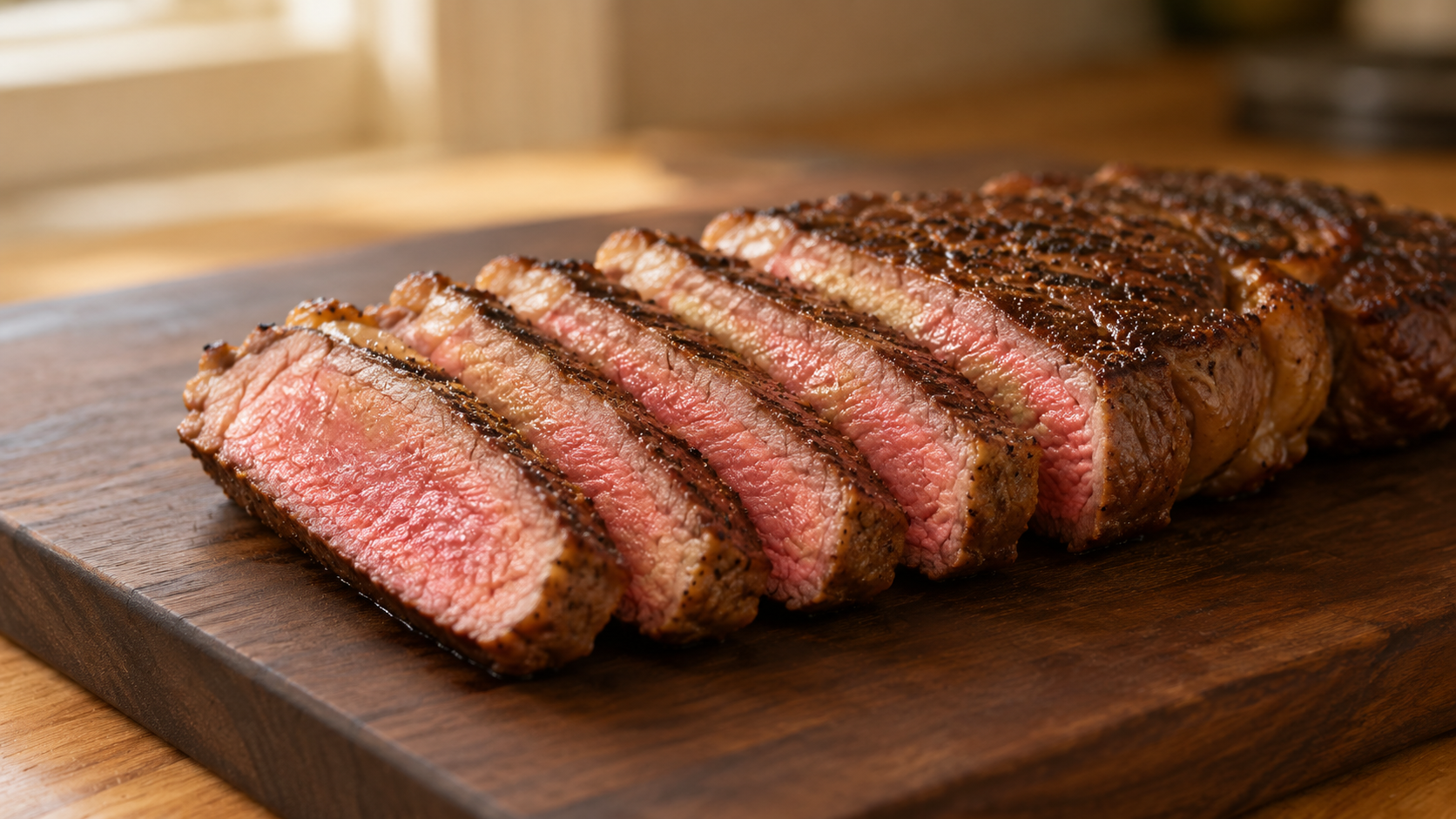
You pulled the steak off the pan at a perfect medium-rare. The crust is deep brown and crackling. It smells incredible. You grab your knife.
Stop.
If you cut into that steak right now, you will watch its juice flood across the cutting board. You didn’t overcook it. You didn’t under-season it. You just skipped the step that actually keeps meat juicy.
Resting. And it has nothing to do with letting the meat cool down.
What Happens Inside Meat When It Cooks
Meat is bundles of long, thin protein fibers. When those fibers hit heat, they contract. Hard.
Picture wringing out a wet towel. The twisting motion squeezes water out of the fibers and toward the center. The same thing happens inside your steak, chicken breast, or roast. As the outer layers heat up and the proteins tighten, moisture gets pushed inward, away from the heat source.
By the time the center reaches your target temperature, the internal structure of the meat is under tension. The juices aren’t calmly sitting there. They’re compressed, pressurized, ready to escape through the first opening they find.
Your knife is that opening.
Why Cutting Early Floods the Board
When you slice into meat the moment it comes off the heat, you sever those still-contracted protein fibers. The pressure releases instantly. The moisture that was squeezed toward the center rushes out through the cut — and onto your cutting board, not into your mouth.
This is not a small effect. The difference between a rested and un-rested piece of meat is visible. An unrested steak leaves a spreading pool of red liquid. A rested one stays clean. The juice stays in the meat where it belongs.
The same piece of meat. The same internal temperature. The same doneness. One is juicy. One is dry. The only variable is time.
What Resting Actually Does
Resting gives contracting protein fibers time to relax. As the meat’s temperature drops a few degrees, the fibers loosen their grip. The moisture that was squeezed toward the center during cooking can now redistribute evenly through the meat.
Two things happen simultaneously:
- The fibers relax, reducing the internal pressure that would otherwise force juice out.
- The moisture redistributes, moving from the saturated center back toward the outer layers that dried out during cooking.
The result is meat that is uniformly moist from edge to center. Every bite is juicy, not just the middle.
This is also why resting improves texture. Relaxed protein fibers are more tender. Contracted fibers are tough and chewy. The same process that retains moisture also makes the meat more pleasant to eat.
How Long to Rest
The rule changes depending on what you’re cooking. Smaller pieces relax faster. Large roasts take longer for the heat gradient to even out and the fibers to release.
Chicken breast: 5 minutes. A boneless breast is thin and cools quickly. Five minutes is enough for the fibers to relax and the moisture to settle. Any longer and it starts heading toward cold.
Steaks (1 to 1.5 inches thick): 5 to 10 minutes. The thicker the steak, the longer the rest. A thin flank steak needs 5. A thick ribeye or strip needs closer to 10.
Large roasts (prime rib, pork shoulder, whole chicken): 15 to 30 minutes. Big pieces hold heat longer and need more time for the center-to-edge temperature difference to stabilize. A whole turkey can rest 30 to 45 minutes and still be warm when you carve it.
Tent the meat loosely with foil during the rest. The foil reflects some heat back, keeping the meat warm, but leaving the sides open lets steam escape. If you wrap it tightly, you trap steam against the surface and soften the crust you worked to build. You want warm meat with a crisp exterior, not steamed meat with a soggy one.
Carryover Cooking: Pull Early
There is a second reason to rest, and it’s just as important as the first. Meat keeps cooking after it leaves the heat.
The outer layers of your steak might be 300°F when you pull it from the pan. The center might be 125°F. During the rest, heat from the hot exterior continues traveling inward. The internal temperature rises 5 to 10°F after the meat leaves the pan.
If you pull a steak at 130°F expecting medium-rare, carryover cooking will push it to 135 or 140°F by the time you slice it. That’s medium. If you pull a chicken breast at 165°F, carryover pushes it toward 170°F — and breast meat dries out fast above 165°F.
The fix is simple: pull your meat 5 to 10°F before your target temperature. The rest finishes the job. No guesswork. No overcooking. Just a thermometer and a little patience.
This principle is baked into the Pan-Seared Chicken Breast recipe and the 40-Minute Salted Steak recipe. Both build resting and carryover cooking into the timing.
What You Actually See
Try this once. Cook two chicken breasts identically. Same pan, same heat, same target temperature. Slice one immediately. Rest the other for 5 minutes.
The unrested breast leaks a pool of clear liquid onto the cutting board within seconds. The rested breast stays clean. When you eat them side by side, the rested one is noticeably juicier and more tender.
Same thermal history. Same doneness. The only difference is 5 minutes of patience.
Your Resting Checklist
- Pull meat 5 to 10°F before your target internal temperature
- Chicken breast: rest 5 minutes, tented loosely with foil
- Steaks: rest 5 to 10 minutes, depending on thickness
- Large roasts: rest 15 to 30 minutes or more
- Tent, don’t wrap. Steam softens crusts.
- Slice against the grain for maximum tenderness
- That juice on the board after slicing a rested piece? Pour it back over the meat. That’s flavor.
Resting is the cheapest cooking upgrade there is. It costs you five minutes and a piece of foil. It requires no skill, no equipment, and no practice. It is the difference between dry meat and juicy meat, and the only thing standing between you and both outcomes is whether you put the knife down and wait.
Cook the Principle
Put this into practice.
40-Minute Salted Steak — 50 min · Beginner Pan-Seared Chicken Breast — 25 min · Beginner