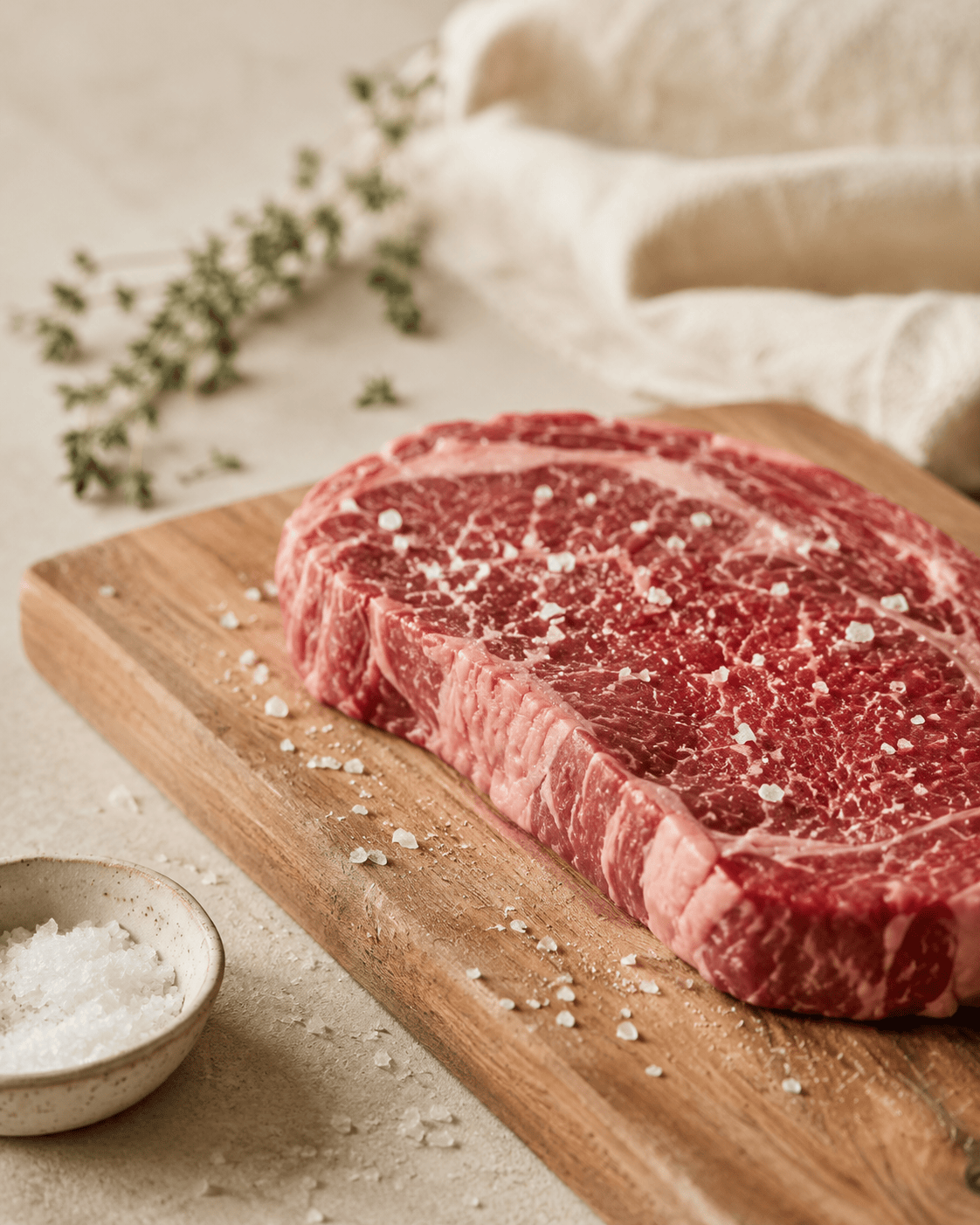
You’ve heard every version.
“Salt it an hour before.”
“No, salt it right before it hits the pan.”
“I always salt mine the night before.”
Someone is wrong. And it’s probably not who you think.
The truth is that salt timing actually matters — but not for the reasons most people repeat. It’s not about “penetrating the meat” or “breaking down proteins” in the way cooking shows describe it. It’s about one thing: what happens to the surface of your steak between the salt hitting it and the pan hitting it.
Get the timing wrong, and you’re steaming your steak instead of searing it.
Here’s exactly what happens, minute by minute.
What Salt Does to Meat (The 60-Second Version)
Salt does two things when it hits the surface of a steak:
- It draws moisture out. Through osmosis, salt pulls water from inside the muscle fibers toward the surface.
- It dissolves into that moisture. The salt crystals dissolve in the water they pulled out, creating a concentrated brine on the surface.
What happens next depends entirely on timing.
The Window You Need to Avoid: 2 to 40 Minutes
If you salt your steak and let it sit for 2 to 40 minutes, you are in the danger zone.
Here’s why:
At the 2-minute mark, salt has pulled water to the surface. The surface is now wet. But there hasn’t been enough time for that water to do anything useful — it just sits there.
A wet surface is the enemy of browning. When your steak hits a hot pan, that surface moisture turns to steam instantly. Steam prevents the Maillard reaction — the chemical process that creates the brown crust and deep, savory flavor you want. Instead of searing, you’re steaming.
This is why the person who salts 20 minutes before cooking gets a grey, sad steak.
Between 2 and 40 minutes, you have the worst of both worlds: moisture on the surface, no reabsorption, no benefit.
If this sounds familiar, you might also want to read Why Your Steak Isn’t Browning (You’re Steaming It).
40 Minutes or More: Where the Magic Happens
After about 40 minutes, something changes.
The moisture on the surface starts to reabsorb back into the meat. And when it goes back in, it carries dissolved salt with it. This is where the “seasoning from within” actually happens — not from the salt penetrating directly, but from salt dissolving in surface moisture and that moisture being drawn back in.
By the 45–60 minute mark, the surface of your steak is noticeably drier than when you started. That’s exactly what you want. A dry surface browns immediately on contact with a hot pan. No steam. No grey. Just crust.
This is dry brining at its simplest. You don’t need special equipment or technique. You need time.
Right Before Cooking (Under 5 Minutes)
If you don’t have 40 minutes, salt immediately before the steak hits the pan.
At under 5 minutes, salt hasn’t had time to pull significant moisture to the surface. The surface is still dry. The salt crystals sit on top of the meat and season the crust directly as it forms.
This works. It’s not ideal — you won’t get the deeper seasoning that time provides — but it produces a much better crust than salting 20 minutes before. If you’re in a rush, this is your move.
Overnight: The Best Crust You’ll Ever Get
For maximum effect, salt your steak and leave it uncovered in the fridge overnight (8 to 24 hours).
What happens:
- Salt draws moisture out (first hour)
- Moisture reabsorbs, carrying salt deep into the meat (hours 2–4)
- The refrigerator’s dry air continues to pull moisture from the surface (hours 4–24)
- You end up with a deeply seasoned steak and an extremely dry surface
The result is a crust so brown and crisp it borders on unfair. This is restaurant-level technique with zero restaurant equipment.
The Summary: When to Salt
| Time Before Cooking | What Happens | Verdict |
|---|---|---|
| 0–5 minutes | Surface stays dry. Salt seasons the crust directly. | Good. Not ideal, but works. |
| 2–40 minutes | Surface is wet. Steams instead of sears. | Avoid. This is the worst window. |
| 40 minutes to 2 hours | Moisture reabsorbs. Surface dries. Salt penetrates. | Great. Minimum for a serious crust. |
| 8–24 hours (fridge) | Maximum penetration. Extremely dry surface. | Best. Restaurant-quality crust. |
Your Checklist: Before You Salt Steak Tonight
- If you have time: salt at least 40 minutes before cooking, leave uncovered at room temperature
- If you have more time: salt the night before, leave uncovered in the fridge
- If you have no time: salt right before it hits the pan. Not 10 minutes before. Not 20. Right before.
- Pat the steak dry with a paper towel before it hits the pan — regardless of timing
- Never salt 2 to 40 minutes before cooking. That’s the window that kills your crust.
Cook the Principle
Cook the Principle
Put this into practice.
40-Minute Salted Steak — 50 min · Beginner
That’s it. Not a recipe. Not a marinade. Not a special cut of meat. Just salt and time.