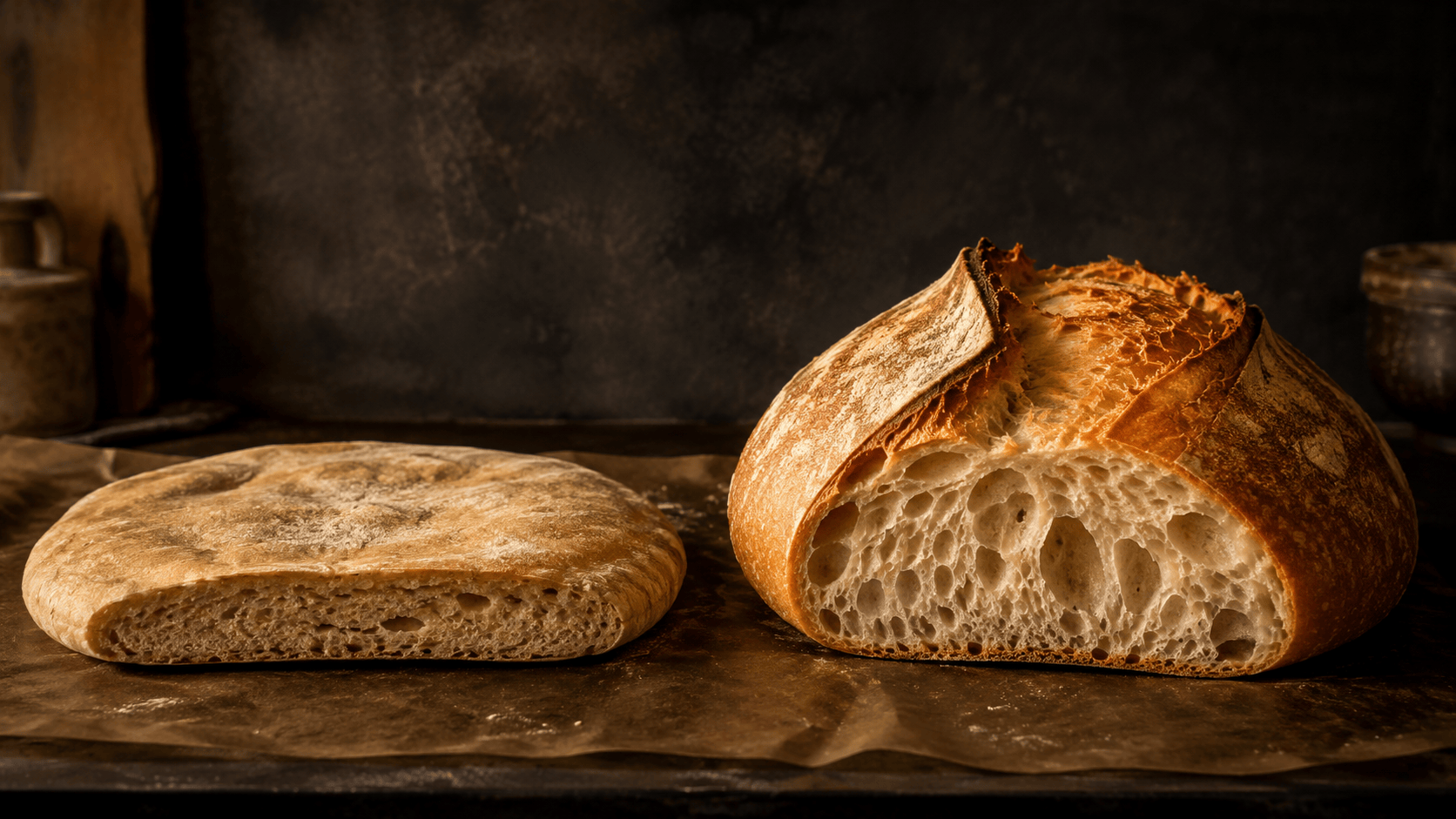
You set your dough to rise and got distracted. Two hours later you returned to a bowl of collapsed goo. It smelled faintly of alcohol. When you poked it, the indentation stayed. It never sprang back.
The dough overproofed. The yeast ate through all the available food and produced so much gas that the gluten network couldn’t hold it anymore. Here’s exactly what happened inside that bowl and whether you can save it.
The Proofing Window
Proofing is fermentation. Yeast consumes sugars in the flour and produces carbon dioxide and ethanol. The carbon dioxide inflates the gluten network like a million tiny balloons. The dough rises.
A properly proofed dough has doubled in size. When you poke it, the indentation springs back slowly, leaving a slight mark. The gluten is stretched but still elastic. The yeast is active but not exhausted.
Overproofing begins when the gluten reaches its elastic limit. The gas pressure exceeds what the network can contain. The gluten strands snap. The gas escapes. The dough collapses.
Why Overproofed Dough Smells Like Alcohol
Yeast produces ethanol as a byproduct of fermentation. In a properly proofed dough, most of that ethanol evaporates during baking. In an overproofed dough, the yeast has produced so much ethanol that the smell is unmistakable. It is not a subtle yeasty aroma. It smells like a brewery.
By the time the dough smells strongly of alcohol, the yeast has consumed most of the available sugars. There is not enough food left for a meaningful second rise. The bread will bake up dense and flat with an off, sour flavor.
Can You Save It
It depends on how far it has gone. If the dough has just started to recede from its peak but still holds some structure, you can punch it down, reshape it, and give it a shorter second proof. The bread will be denser than intended but still edible.
If the dough has collapsed completely into a liquid puddle that smells strongly of alcohol, it is done. The gluten is shredded. The yeast is spent. You cannot rebuild what has been destroyed. Start over.
The Fix for Perfect Proofing
1. The poke test. Flour a finger and poke the dough about half an inch deep. The indentation should spring back slowly and leave a slight mark. If it springs back instantly and disappears, the dough is underproofed. If it stays sunken, it is overproofed.
2. Watch, don’t clock. Recipes say “let rise for 1 hour.” Temperature, humidity, and yeast activity can cut that in half or double it. Go by the dough’s appearance and feel, not the clock.
3. Cooler is safer. A slower rise in a cooler spot gives you a wider window and develops more flavor. The fridge is your friend for long proofs.
Your Proofing Checklist
- ☐ Doubled in size, not tripled
- ☐ Poke test: slow spring back, slight mark left
- ☐ No strong alcohol smell
- ☐ Cooler room = more time, more flavor
- ☐ If collapsed and boozy, start over
Proofing is a window. Once it closes, no amount of hope reopens it.