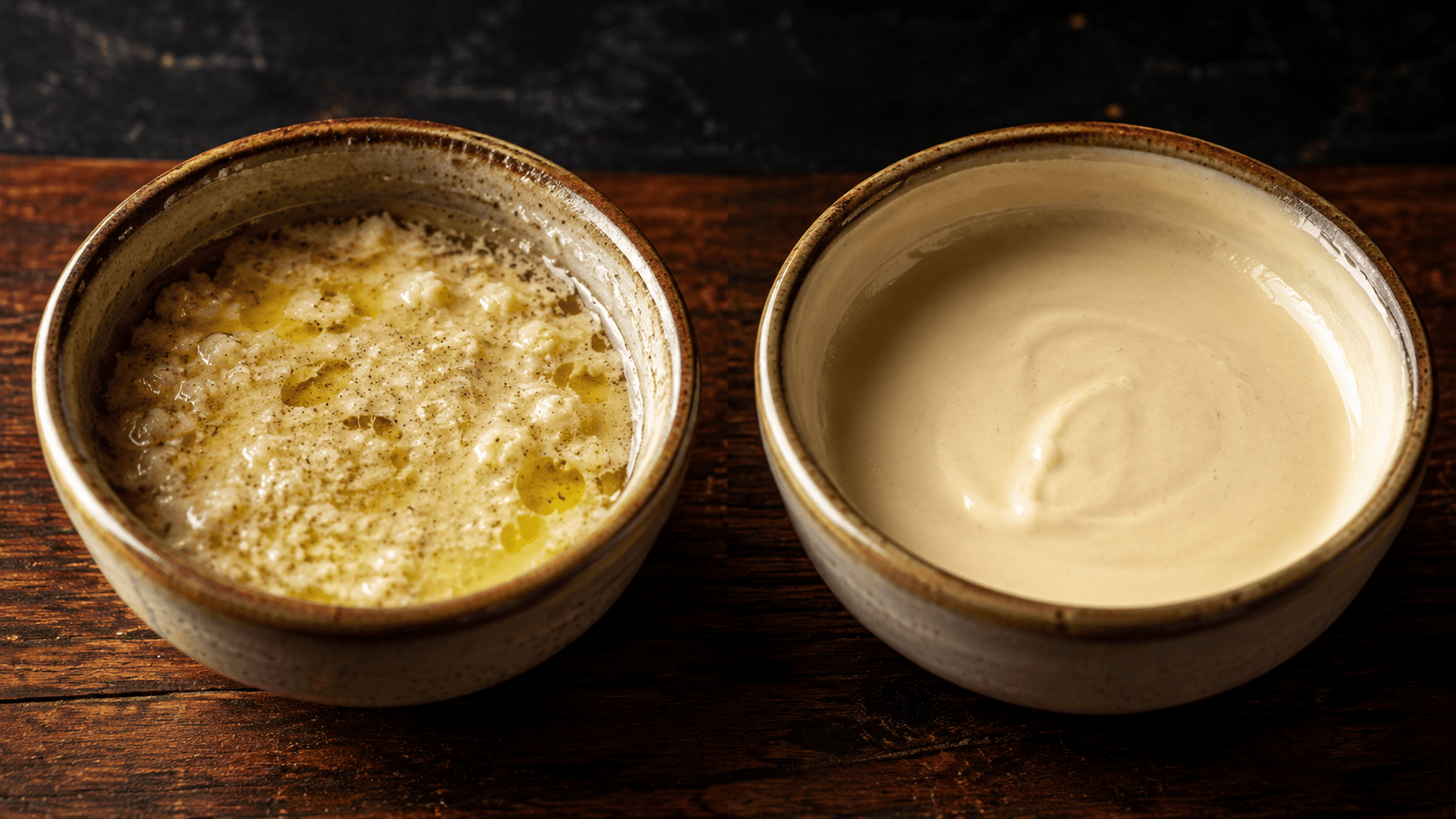
You made a beautiful cream sauce. It was silky and smooth, coating the back of a spoon. You turned to grab the pasta and when you turned back the sauce had split. Oily liquid pooling at the edges. Curdled-looking solids in the center.
You stirred it hard, hoping to bring it back together. It got worse. Here’s what happened and why stirring harder was the wrong response.
What a Cream Sauce Actually Is
A cream sauce is an emulsion. Tiny droplets of butterfat are dispersed throughout a water-based liquid, kept separate by proteins and emulsifiers in the cream. As long as those fat droplets stay small and separate, the sauce is smooth. When they merge into larger pools, the sauce breaks.
Three things cause a cream sauce to break: too much heat, too much acid, and too much fat relative to the water phase.
The Heat Problem
Dairy proteins are sensitive to temperature. Above about 175°F (80°C), the proteins in cream begin to denature and clump together. When they clump, they can no longer hold the fat droplets apart. The fat coalesces and the sauce separates.
A rolling boil is around 212°F. That is more than hot enough to denature dairy proteins. A gentle simmer is safer. The difference between a simmer and a boil is the difference between a stable sauce and a broken one.
The Acid Problem
Acid accelerates protein denaturation. A small amount of acid — a squeeze of lemon, a splash of wine — adds brightness to a cream sauce. Too much acid too fast and the proteins curdle instantly. This is why you temper dairy into acidic mixtures rather than dumping acid into hot cream.
The Fat Problem
Cream is about 35% fat. That fat is held in an emulsion by the water and protein in the cream. Add butter to a cream sauce and you are adding more fat without adding more water or protein to hold it. Eventually the emulsion collapses under the fat load.
The Fix
1. Keep the heat at a simmer, not a boil. Small bubbles around the edges. Not a rolling surface.
2. Add acid at the end, off the heat. Stir it in after you’ve pulled the pan from the burner. The residual heat is enough to incorporate it.
3. If it breaks, don’t stir harder. Remove it from the heat immediately. Add a tablespoon of cold water and whisk gently. The cold water cools the sauce and adds more water phase for the fat to disperse into. A splash of cold cream works too.
4. Tempering matters. When adding cold dairy to hot liquid, add a small amount of the hot liquid to the dairy first. This warms it gradually. Then add the tempered dairy back to the pot.
Your Cream Sauce Checklist
- ☐ Simmer, never boil
- ☐ Add acid at the end, off heat
- ☐ If it breaks: cold water, gentle whisk
- ☐ Temper cold dairy into hot mixtures
- ☐ Less is more with added fat
A broken sauce is not ruined. Cold water and patience bring it back.