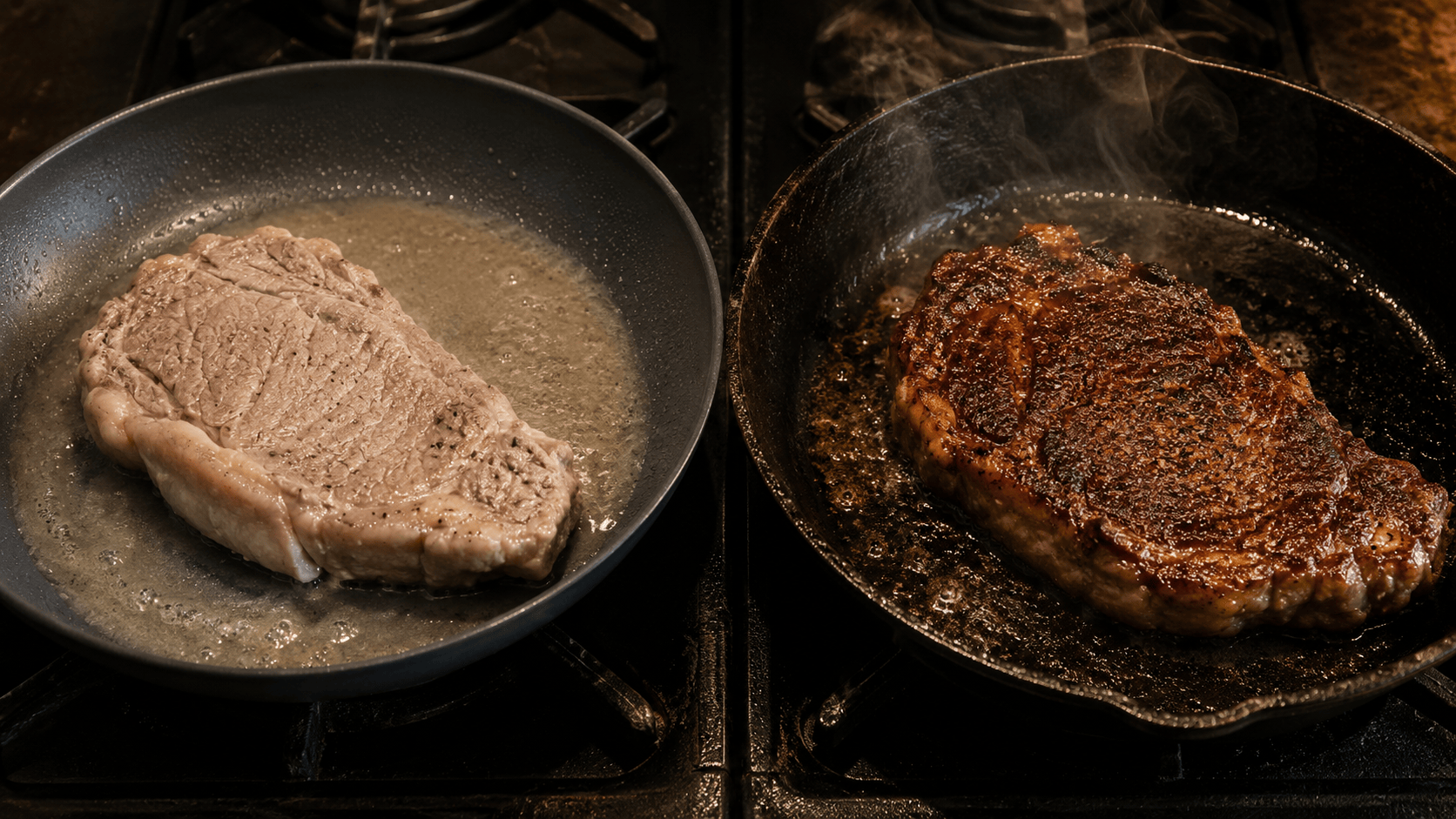
You put a steak in a hot nonstick pan. You heard the sizzle. You waited for the crust. What you got was a gray piece of meat that spent ten minutes steaming in its own juices.
The pan was hot. The steak was dry. So why didn’t it brown?
The answer has nothing to do with your technique and everything to do with the pan. Nonstick pans are designed for eggs, not steaks. Here’s why.
What Searing Actually Requires
Browning is the Maillard reaction. Amino acids react with reducing sugars at temperatures above 285°F (140°C) to produce hundreds of new flavor and color compounds. The reaction accelerates as the temperature climbs.
To get a good sear, the surface of the meat has to stay above 285°F even as cold, wet meat pulls heat out of the pan. The moment the surface drops below that threshold, browning stops and steaming begins.
This is where pan material matters. A pan’s ability to sear is determined by its heat capacity and thermal conductivity. Heat capacity is how much energy the pan stores. Thermal conductivity is how fast it transfers that energy to the food.
Why Nonstick Fails at Searing
Nonstick pans are almost always made of thin aluminum with a PTFE coating. Aluminum has decent thermal conductivity but very low heat capacity. The pan heats up fast and cools down fast. When cold meat hits the surface, the pan temperature plummets below the Maillard threshold. The meat steams in its own juices.
The nonstick coating also prevents fond from forming. Fond is the browned bits that stick to the pan during searing. In a nonstick pan, those bits slide around instead of staying in contact with the hot surface. You lose the very thing that creates a crust.
Why Cast Iron Wins
Cast iron is heavy. A 12-inch skillet weighs 6 to 8 pounds. All that mass is thermal capacity. When cold meat hits a hot cast iron pan, the pan has enough stored energy to keep the surface temperature in the browning zone. The meat sears instead of steams.
Cast iron also has moderate thermal conductivity. It heats slowly and evenly, and it holds that heat. Once it’s hot, it stays hot. The rough surface grips the meat and promotes fond formation.
Carbon steel works the same way for the same reasons. Lighter weight, same principle.
The Fix for a Proper Sear
1. Use cast iron or carbon steel. Heavy pan, preheated properly. The pan should be hot enough that a drop of water skitters across the surface.
2. Dry the meat. Pat it with paper towels. Surface moisture has to boil off before browning begins. Every second of boiling is a second of no Maillard.
3. Don’t crowd the pan. Leave space between pieces. Overcrowding drops the pan temperature and steams everything.
4. Don’t move the meat. Let it sit. The crust releases naturally when it’s ready. If you have to pry it off, it’s not done.
Your Sear Checklist
- ☐ Cast iron or carbon steel pan
- ☐ Preheat until water skitters
- ☐ Meat patted completely dry
- ☐ No overcrowding
- ☐ Don’t touch it until it releases
A gray steak is a pan problem, not a you problem. Use the right tool.